

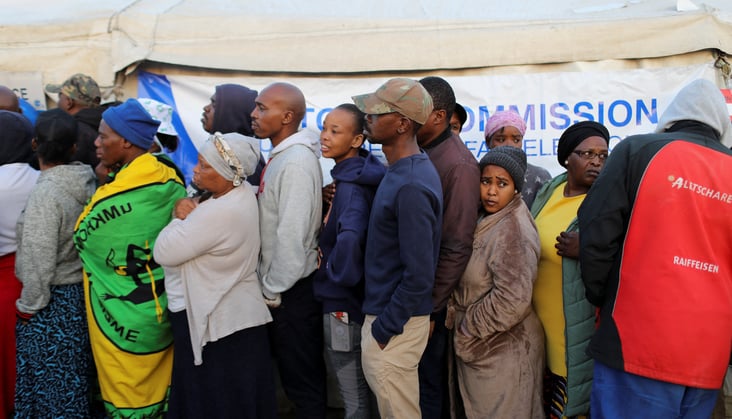
South Africans have begun voting in local government elections widely regarded as a major test of support for the governing African National Congress (ANC), amid growing public frustration over unemployment, crime, corruption and poor delivery of basic services.
Polling stations opened at 7:00 a.m. local time on Wednesday, November 4, with approximately 29.2 million registered voters expected to participate across the country.
According to the Electoral Commission of South Africa (IEC), voting is taking place at 23,696 polling stations across the country’s nine provinces, with about 188,000 electoral officials deployed to oversee the exercise.
The elections will determine representatives for eight metropolitan municipalities, 44 district municipalities and 205 local municipalities. The elected council members will subsequently choose mayors to lead their respective municipalities.
The ANC, which led South Africa’s struggle against apartheid and governed the country since the first democratic elections in 1994, faces the possibility of another decline in electoral support.
The party received less than 50 per cent of the vote for the first time in municipal elections in 2021. It also lost its parliamentary majority in the 2024 national elections, forcing it to form a government of national unity with the Democratic Alliance (DA) and other political parties.
Opinion polls ahead of Wednesday’s elections suggest the ANC could fall below 40 per cent of the national vote, although the final outcome remains uncertain.
Major campaign issues include unreliable water and electricity supplies, deteriorating roads, unemployment, rising living costs, crime and concerns over municipal corruption.
Johannesburg, South Africa’s largest city and economic hub, is among the major battlegrounds. The city has experienced five mayoral changes in four years and remains a target for the opposition Democratic Alliance, which has fielded its former leader, Helen Zille, as its mayoral candidate.
The elections also mark the first local government contest for former President Jacob Zuma’s uMkhonto weSizwe (MK) Party, which is seeking to expand its political influence, particularly in KwaZulu-Natal.
With no single party expected to secure outright majorities in several major metropolitan councils, coalition negotiations could play a significant role in determining which parties eventually control local governments.
South African President Cyril Ramaphosa has described municipal governance as central to restoring public confidence in democratic institutions, while urging citizens to participate in the electoral process.
Voting is scheduled to close at 9:00 p.m. local time, with final results expected on Sunday, November 8.
The outcome is expected to provide an important indication of the ANC’s standing among voters and could influence the party’s political direction ahead of its next leadership conference in December 2027.