

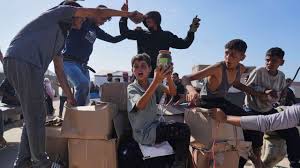
Chaos erupted in the southern Gaza city of Rafah on Tuesday as thousands of Palestinians overwhelmed a newly opened humanitarian aid center operated by the controversial U.S. and Israeli-backed Gaza Humanitarian Foundation (GHF). The compound, established just a day prior, was swiftly overrun by desperate civilians, prompting scenes of panic, damaged infrastructure, and military intervention.
Footage shared online showed vast crowds tearing down fences and crossing earth berms to access the facility. At one point, the situation forced GHF staff to retreat as the number of people seeking food aid became unmanageable.
Israeli troops stationed nearby responded by firing warning shots, causing further panic. Several people were reportedly injured in the rush that followed.
The GHF began operations in Gaza on May 26, following nearly three months of an Israeli blockade that severely limited the entry of humanitarian supplies. The foundation’s goal is to distribute emergency food assistance to over one million Palestinians, but it has so far delivered only 8,000 aid boxes — a fraction of what is needed. Each box is designed to feed a family of approximately five people for three and a half days.
The distribution center in Rafah is one of four currently being operated by the GHF. According to the organization, Tuesday’s incident demonstrates both the extreme level of need and the volatility of attempting aid distribution under such conditions.
The GHF has been the subject of sharp criticism from major humanitarian agencies and UN officials. Detractors accuse the organization of politicizing aid delivery and imposing security and surveillance measures — including biometric scanning and facial recognition — that could deter recipients.
Adding to the controversy, GHF Executive Director Jake Wood resigned just days before the Rafah incident, citing moral concerns and stating that “it is not possible to uphold humanitarian principles under the current structure.” In his resignation statement, Wood urged Israel to allow greater, unimpeded humanitarian access into Gaza.
Tuesday’s events further underscore the deepening humanitarian crisis in the territory, where food, medical supplies, and clean water remain in critically short supply. Aid workers warn that without a significant scale-up in neutral, coordinated, and unrestricted assistance, the situation is likely to deteriorate further.