

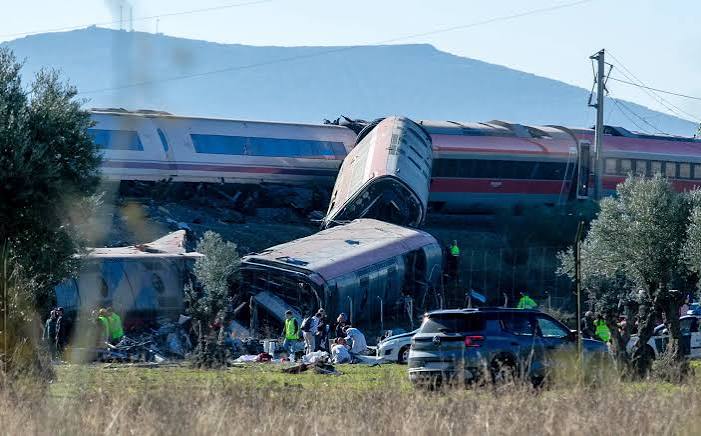
At least 68 people have been killed and dozens injured after two high-speed trains collided in central Spain, prompting a major rescue operation and a full investigation into the country’s second deadly high-speed rail crash this year.
The collision occurred on Wednesday near Urda, in the Toledo province of Castilla-La Mancha, when a Renfe high-speed train travelling from Madrid to Seville struck the rear of a stationary Iryo train.
Officials said 397 passengers were aboard the Renfe train, while 147 people were travelling on the Iryo service. Several carriages derailed in the impact, with some plunging down an embankment. At least 80 people were injured, including 15 described as being in very serious condition.
Spain’s Transport Minister, Óscar Puente, said a computer communications failure had caused a railway safety system to stop functioning along a section of the line. The failure automatically halted trains operating on the affected stretch.
According to Puente, a central control centre in Madrid subsequently authorised the Renfe train to resume its journey despite an active stop signal. He described the decision as “inexplicable” and said investigators were examining how the order was made. The train travelled about 25 kilometres before colliding with the stationary Iryo service.
The exact circumstances surrounding the crash remain under investigation. Authorities are examining the signalling failure, communications between the control centre and train operators, and the decisions made before the collision.
Prime Minister Pedro Sánchez visited the crash site and pledged a full investigation, saying any safety failures or negligence uncovered would be addressed. His government has also declared three days of national mourning beginning Thursday.
The disaster is Spain’s second deadly high-speed rail collision this year. In January, 46 people were killed when two trains collided near Adamuz in Córdoba province.
The latest crash has renewed questions about the safety and maintenance of Spain’s extensive high-speed rail network, which is one of the largest in the world. It is also the deadliest European rail accident since the 2013 derailment in Santiago de Compostela, which killed 80 people.
Rescue teams, firefighters, police officers and soldiers worked through the wreckage to recover victims and search for survivors. Rail services between Madrid, Ciudad Real and parts of Andalusia were suspended following the collision.
Authorities are continuing to identify the victims and investigate the cause of the disaster, while families await information about relatives who were on board the two trains.